
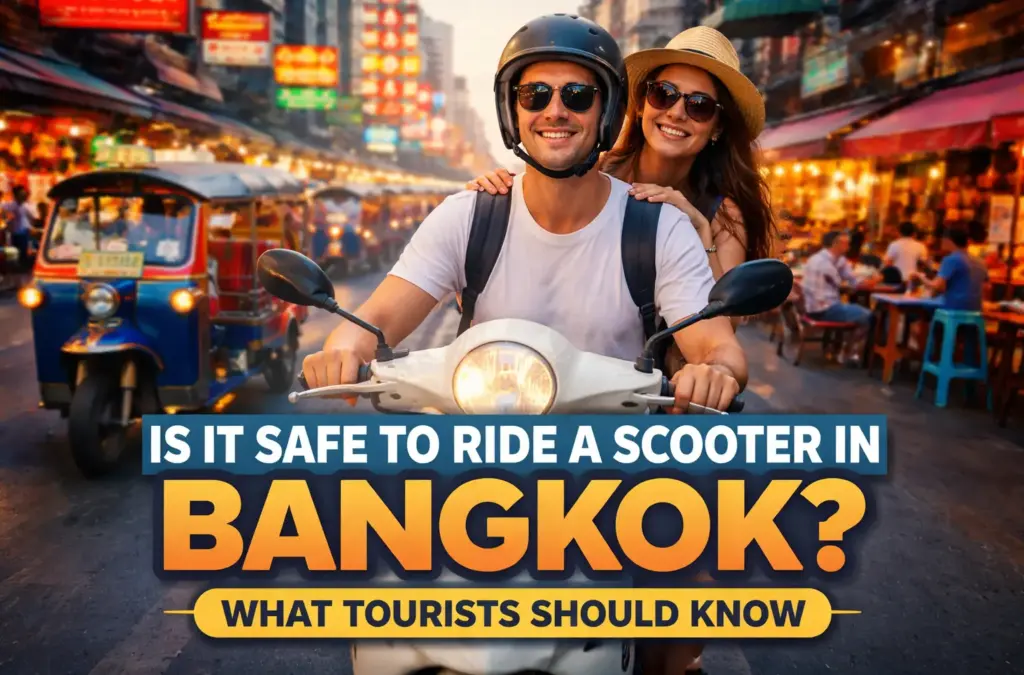
Bangkok traffic is intense, chaotic, and loud. Ask Reddit and you’ll get a wall of responses telling you to never ride a scooter in Bangkok. But thousands of tourists and expats do exactly that, every single day, without problems. The difference between a safe ride and a disaster comes down to a few specific habits, not luck.
This isn’t a generic road safety lecture. This is what you actually need to know if you’re thinking about renting a scooter in Bangkok in 2026, written by someone who rides these streets daily and runs a scooter rental business here.
Bangkok Traffic Is Different. Not Necessarily Worse.
Most first-timers arrive expecting Bangkok to feel like a video game gone wrong. It doesn’t. Bangkok traffic moves slower than you expect. In central Bangkok during the day, average speeds run between 15 and 25 km/h. That’s slower than a bicycle sprint. Compare that to Phuket’s beachfront roads where you’ll hit 60 km/h stretches, or Chiang Mai’s mountain roads with blind corners and gravel patches. Speed is what kills people, and Bangkok doesn’t have much of it.
Drivers in Bangkok are also used to scooters. They expect you. The chaos has a rhythm, and once you spend 20 minutes in it, you start to feel that rhythm. Buses hug the left, taxis dart right for passengers, scooters filter to the front at red lights. It’s a system, just not one written in any manual.
The road quality in Bangkok is also better than most of Thailand. More traffic lights, more lanes, more signage. Where fatal accidents actually happen is the countryside: long straight roads at high speed, poor surfaces, no central dividers. Rural Thailand is genuinely more dangerous than Bangkok’s urban grid. That’s not an opinion, that’s what the accident statistics show every year.
8 Rules That Keep You Safe
Always wear your helmet
Not just because police checkpoints will hand you a 400 THB fine if you don’t. Because a fall at 20 km/h onto asphalt will crack your skull. That’s not exaggeration, that’s physics. RentLab includes two helmets with every rental. Put them on, both of you, every single ride.
Skip rush hour for your first few rides
7 to 9 AM and 5 to 7 PM are the worst windows on Bangkok roads. Cars, buses, taxis, motorbike taxis, and thousands of other scooters all fight for the same lane at the same time. If you just arrived in Bangkok, your first ride should be midday or after 8 PM when traffic thins out considerably. Get comfortable with how the roads feel before you throw yourself into the rush hour crush.
Stay left, ride with the flow
Scooters belong in the left lane in Thailand. You’ll see locals weaving through gaps like they were born on two wheels, because many of them basically were. Don’t try that yet. Stay in your lane, match the speed of traffic around you, and signal before changing lanes. The left lane keeps you away from faster-moving cars and puts you in predictable positions where other drivers can account for you.
Watch intersections, not the road
Most accidents in Bangkok don’t happen on open road. They happen at intersections. Buses turn without looking. Taxis cut across three lanes to grab a passenger. Motorcycles run red lights, especially the first two seconds of a red. When you approach any intersection, slow down, even if your light is green. Never be the first vehicle to cross on a fresh green. Wait two seconds, let someone else go first, and then move.
Use a phone holder, not your pocket
Google Maps is how you navigate Bangkok on a scooter. The sois (side streets) are numbered but not always logical to a newcomer, and taking a wrong turn can dump you on a fast road with nowhere obvious to turn around. RentLab provides a phone holder mount with every scooter. Set your destination before you start the engine, glance at it at red lights, and keep both hands on the bars while moving.
Wet roads change everything
Bangkok’s rainy season runs May through October, and when it rains, it doesn’t mess around. Your braking distance roughly doubles on wet tarmac. White lane markings become slippery, and metal drain covers turn into ice patches. If rain hits hard while you’re riding, pull into the nearest 7-Eleven or petrol station and wait it out. Twenty to thirty minutes is usually enough. Bangkok’s tropical storms are intense but short. Riding through the worst of it is not worth it.
Know your route before you ride
Getting lost in Bangkok on a scooter leads to panic decisions: sudden turns, going the wrong way down a one-way soi, stopping abruptly in moving traffic. Spend 30 seconds looking at your map before you leave. Know which direction you’re heading, which major road you’re aiming for. Bangkok’s soi numbering makes sense once you know that odd-numbered sois sit on one side of the street, even-numbered on the other.
Don’t ride after drinking
Thailand’s legal blood alcohol limit is 0.05%. Police set up checkpoints near entertainment districts, specifically around Thonglor, Ekkamai, Khao San Road, and RCA, particularly after midnight on weekends. Beyond the legal risk, Bangkok traffic demands your full attention even when you’re completely sober. After a night out, take a Grab home. Your scooter will be exactly where you left it in the morning, and you’ll be alive to ride it.
What to Wear
You don’t need full motorcycle gear for Bangkok city riding at 20 to 30 km/h. But you do need more than sandals and a singlet. Closed shoes are non-negotiable. Long pants matter more than most people think, not for style, but because the single most common scooter injury for passengers is an exhaust pipe burn on the ankle or calf. It happens fast, it’s painful, and it leaves a mark. Long pants eliminate that risk entirely. A shirt with sleeves keeps road rash from becoming a serious wound if you do slide. You’ll see tourists riding in flip flops and shorts constantly. Most of them are fine. Some of them aren’t.
Areas to Avoid as a Beginner
First, expressways and toll roads are off-limits for scooters under 150cc anyway, so that’s not a choice you need to make. In terms of roads that are technically legal but genuinely unpleasant for beginners, Ratchadaphisek during rush hour is a war zone of buses and trucks. Rama IV near Khlong Toei moves fast and has aggressive lane changes. The roundabout at Victory Monument has confused experienced riders, let alone someone on their first Bangkok ride.
Where to start instead: the Sukhumvit side sois between Asok and On Nut are wide, well-marked, and slower-paced. The On Nut, Udom Suk, and Bang Na area, which is where RentLab is based, is genuinely beginner-friendly with good road surfaces and clear intersections. Any residential neighborhood away from the main arterial roads is good practice ground. Start there, build your confidence, then expand your range.
What If Something Goes Wrong?
Minor incident first: if you have a low-speed slide or a minor scrape, check yourself before worrying about the scooter. For a full breakdown of your liability, read what happens in an accident with a rental scooter in Thailand. Move the bike off the road if you can do it safely. Take photos of the scooter, the road, and anything else involved. Then call the rental shop.
For anything more serious, 1669 is the emergency medical number in Thailand and 191 is the police. If there’s any damage to another vehicle or person, you need a police report. Your insurance claim depends on that document. Don’t skip it even if the other party says you don’t need one. With RentLab, insurance is included with every rental, and WhatsApp support is available around the clock to help you through whatever’s happened. You won’t be left figuring it out alone on the side of a Bangkok road.
One more thing: if you’re riding without a valid international driving permit (IDP) or a Thai license, your insurance coverage may be affected in a serious accident. Sort your license situation before you ride, not after.
The Honest Bottom Line
Bangkok is absolutely rideable. It’s not the death trap the Reddit threads make it out to be. Respect the traffic, wear your helmet, skip rush hour for the first day or two, and stay sober. Do those things and you’ll be fine.
The reward is real freedom. A BTS train gets you between malls. A Grab gets you from A to B. A scooter gets you everywhere in between, down the sois, into the neighborhoods, through the markets, past the canal paths. Explore the best routes to ride in Bangkok or check the rental prices and see what works for your trip. If you want to actually explore Bangkok rather than just visit it, riding gives you access to a version of this city that most tourists never see. Book your scooter and go find it.
Looking for a well-maintained motorbike rental in Bangkok? RentLab includes insurance, two helmets, and 24/7 support with every booking.