
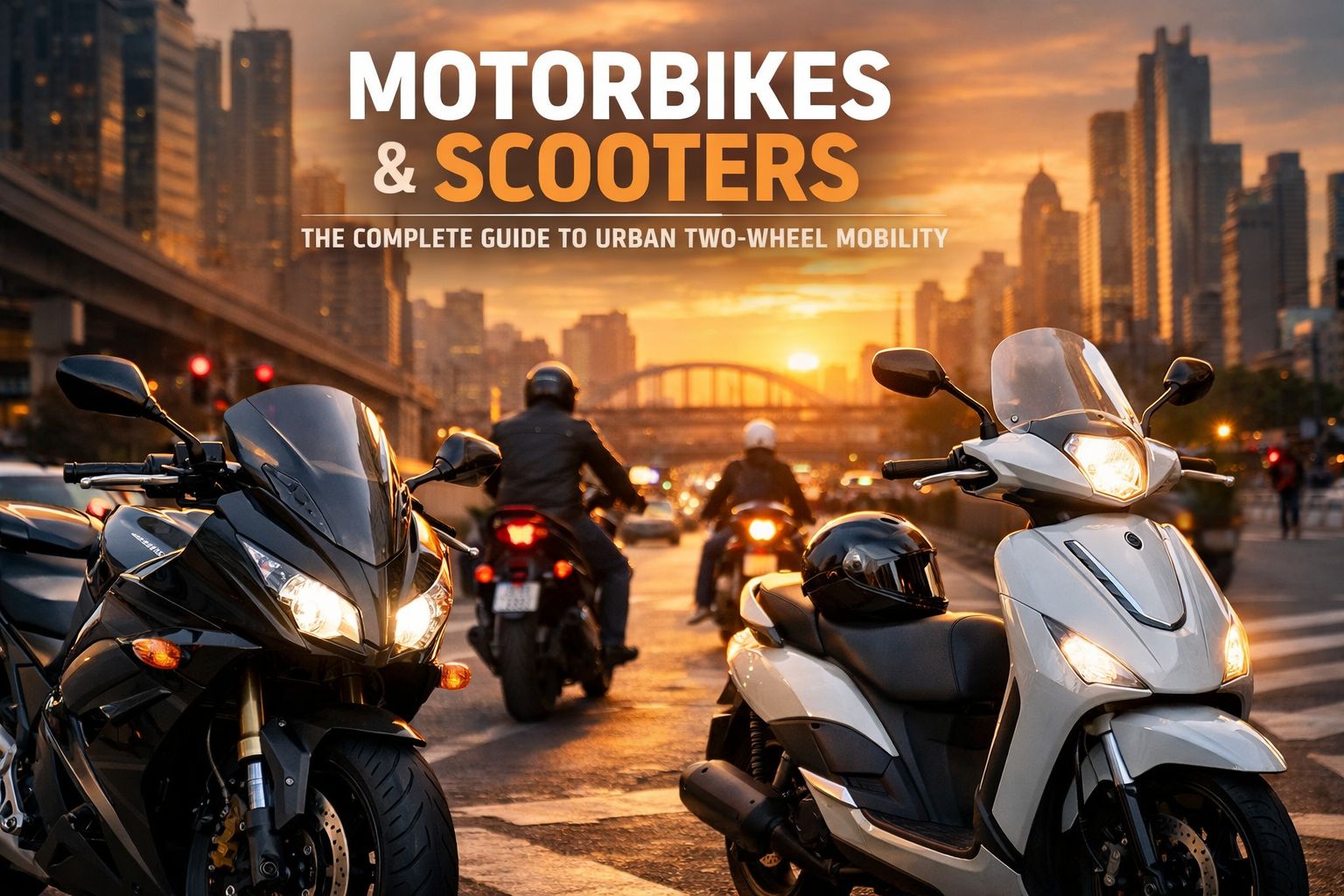
Introduction: Why Motorbikes and Scooters Deserve Their Own Category
Motorbikes and scooters are no longer niche vehicles reserved for enthusiasts, couriers, or emerging markets. They have evolved into one of the most practical, scalable, and globally relevant forms of personal transportation. From dense Asian megacities to European old towns and increasingly even North American urban centers, two-wheeled vehicles are quietly solving problems that cars never could: congestion, parking scarcity, fuel efficiency, and cost of ownership.
This category, Motorbikes & Scooters, exists to build a structured, authoritative knowledge base around everything related to two-wheel mobility. It is intentionally broad. It covers not just riding, but ownership, usage, economics, safety, maintenance, regulations, technology trends, and future mobility systems. That breadth matters, because it allows this category to support many subtopics later—ideal for long-term SEO growth and future guest posts without topical dilution.
Before diving into models, brands, or riding styles, it’s important to understand why motorbikes and scooters matter today more than ever, and how they fit into the modern transportation ecosystem.
The Global Role of Two-Wheeled Transportation
Two-wheelers represent the most widely used motorized transport category on Earth. In many countries, they are not an alternative—they are the default.
In Southeast Asia, India, parts of Southern Europe, and Latin America, scooters and motorbikes dominate daily life. In cities like Bangkok, Hanoi, Jakarta, Rome, or Barcelona, two-wheel vehicles outperform cars in real-world mobility metrics: average speed, parking time, fuel consumption, and cost per kilometer.
Meanwhile, developed markets are rediscovering them for new reasons:
- Urban congestion is worsening, not improving
- Cities are reducing parking availability
- Fuel and insurance costs continue to rise
- Younger generations value flexibility over ownership
Scooters and motorbikes fit neatly into this new reality.
Defining the Difference: Motorbike vs Scooter (Beyond the Obvious)
At a glance, the distinction seems simple. Scooters are automatic, step-through, smaller-wheeled. Motorbikes are manual, tank-mounted, larger-wheeled. In practice, the difference is more nuanced and increasingly blurred.
Scooters prioritize:
- Ease of use
- Comfort in stop-and-go traffic
- Storage and practicality
- Low learning curve
Motorbikes emphasize:
- Mechanical engagement
- Stability at speed
- Performance and control
- Modularity and tuning potential
However, modern designs are collapsing these boundaries. Maxi-scooters now reach engine sizes once reserved for touring motorcycles, while entry-level motorbikes are becoming lighter, more forgiving, and commuter-friendly.
This category will treat scooters and motorbikes as overlapping systems rather than rigidly separated worlds.
A Brief Evolutionary History of Two-Wheelers
Understanding today’s motorbike and scooter market requires a short look backward.
Early motorized two-wheelers emerged in the late 19th century as experimental machines—bicycles with engines bolted on. Over time, two distinct evolutionary paths formed.
One path led toward performance, speed, and mechanical sophistication. This became the modern motorcycle industry, driven largely by European engineering and later refined by Japanese mass production.
The other path prioritized accessibility and simplicity. This produced scooters—vehicles designed to be clean, easy to ride, and suitable for everyday clothing and short trips. Post-war Europe played a major role here, with scooters becoming symbols of urban recovery and personal freedom.
Japanese manufacturers eventually mastered both paths, combining reliability, scale, and affordability. Brands like Honda and Yamaha reshaped the global market by making two-wheelers reliable enough for daily life and cheap enough for mass adoption.
That historical split still influences design philosophy today.
Why Scooters Dominate Cities
Scooters are not popular by accident. They are engineered for cities.
Key urban advantages include:
- Automatic transmissions that eliminate clutch fatigue
- Flat floors that allow relaxed posture and cargo carrying
- Integrated storage for helmets, groceries, or tools
- Compact dimensions that simplify filtering and parking
In real-world urban conditions, especially where traffic density is high, scooters often outperform motorbikes in average trip time. They also attract riders who would never consider a manual motorcycle, dramatically expanding the user base.
This is why scooters are foundational to shared mobility, delivery fleets, and rental operations worldwide, including professional services such as RentLab, where reliability, ease of use, and low rider onboarding time matter more than raw performance.
Why Motorbikes Still Matter
Despite scooter dominance in cities, motorbikes remain irreplaceable in several domains.
They offer:
- Greater wheel stability at higher speeds
- Superior suspension travel on uneven roads
- Better heat management under sustained load
- Higher power-to-weight ratios
For suburban commuting, highway travel, long-distance touring, and sport riding, motorbikes still outperform scooters in both safety margins and rider control.
Importantly, motorbikes also attract a different psychology. Riders often form stronger emotional bonds with motorbikes than with scooters. This leads to higher accessory spending, customization, brand loyalty, and community formation—all critical for content depth and monetization potential later.
Engine Sizes and Practical Reality
One of the most misunderstood aspects of two-wheel ownership is engine displacement. Bigger engines are not always better, especially in urban contexts.
Small displacement engines (100–155cc) often deliver the highest efficiency-to-utility ratio. They:
- Consume minimal fuel
- Are easier to maintain
- Weigh less, improving maneuverability
- Cost less to repair and insure
Mid-range engines (150–300cc) form the backbone of mixed urban-suburban use. They strike a balance between agility and highway capability.
Large displacement machines (300cc and above) serve specialized roles: touring, sport riding, two-up travel, or long distances.
This category will treat engine size as a tool, not a status symbol.
Transmission Types and Rider Experience
Transmission design heavily shapes how a vehicle feels.
Automatic CVT transmissions dominate scooters. They trade mechanical efficiency for smoothness and simplicity. For city riding, this trade-off is often worth it.
Manual transmissions dominate motorbikes. They provide:
- Engine braking control
- Torque modulation
- Better thermal efficiency
Semi-automatic and DCT systems are now blurring the line, offering clutch-free operation with gear control. These technologies are particularly relevant for future urban mobility and will be explored deeper in later articles.
Safety Reality: Physics Always Wins
No discussion of motorbikes and scooters is complete without acknowledging risk. Two-wheelers offer less physical protection than cars. This is not a moral judgment—it’s physics.
However, risk is not binary. It is a function of:
- Vehicle type
- Rider behavior
- Traffic environment
- Infrastructure quality
Scooters often operate at lower speeds but in denser traffic. Motorbikes may travel faster but often in clearer flow. Both can be safe or dangerous depending on context.
Modern safety technologies—ABS, traction control, better tires, and improved frame geometry—have dramatically reduced accident severity when used correctly.
Education and realistic expectations matter more than fear-based narratives.
Economic Logic: Cost per Kilometer
When analyzed objectively, motorbikes and scooters deliver one of the lowest cost-per-kilometer figures of any motorized transport.
Expenses break down into:
- Purchase price
- Fuel
- Maintenance
- Tires
- Insurance
In many regions, total operating cost is less than public transport subscriptions, while offering far greater flexibility.
This economic efficiency is one reason two-wheelers continue to dominate in emerging markets and are now resurging in developed cities under cost pressure.
Environmental Perspective (Without Greenwashing)
Two-wheelers are not zero-impact, but they are generally more efficient than cars when measured per passenger kilometer.
Smaller engines, lower weight, and reduced material usage give scooters and motorbikes a structural advantage. Electric scooters amplify this further, though battery production introduces new trade-offs that must be discussed honestly.
This category will treat environmental impact with realism, not marketing slogans.
Why This Category Is Structured Broadly
Motorbikes & Scooters is intentionally designed as a pillar category. It can later branch into:
- Buying guides
- Maintenance tutorials
- Brand comparisons
- Legal and regulatory content
- Rental and fleet management
- Urban mobility analysis
- Electric and future technologies
That structure makes it ideal for:
- Internal linking
- Topical authority
- Selling guest posts without diluting relevance
Everything published under this category reinforces the same semantic theme: two-wheel mobility as a system, not a hobby.
Design Philosophy: Why Motorbikes and Scooters Are Built the Way They Are
Every motorbike or scooter is the result of hundreds of engineering trade-offs. Nothing is accidental. Seat height, wheel size, frame geometry, engine placement, cooling method, and even body panels all reflect a specific usage philosophy.
Scooters are engineered from the outside in. Designers start with rider posture, ease of mounting, cargo capacity, and urban maneuverability. The engine and drivetrain are arranged to serve those goals, not the other way around. This is why most scooters use:
- Rear-mounted engines
- Smaller wheels
- Step-through frames
- Integrated bodywork
Motorbikes are engineered from the inside out. The engine is the structural core. The frame exists to support power delivery, handling stability, and rider feedback. Comfort and convenience are secondary, not primary, goals.
Neither approach is superior in isolation. They simply optimize for different problems.
Wheel Size, Stability, and Real-World Handling
Wheel size is one of the most underestimated design factors in two-wheel behavior.
Smaller wheels, common on scooters, allow:
- Lower seat heights
- Tighter turning radius
- Compact overall dimensions
However, they are more sensitive to potholes, road imperfections, and high-speed instability.
Larger wheels, typical of motorbikes, provide:
- Better gyroscopic stability
- Improved obstacle absorption
- More predictable behavior at speed
This is why scooters feel effortless in city traffic but can feel nervous on poor roads at higher speeds, while motorbikes feel planted on highways but heavier in tight urban spaces.
Understanding this trade-off helps riders choose rationally instead of emotionally.
Frame Construction and Longevity
Most modern scooters use underbone or pressed steel frames. They are cost-effective, durable, and flexible enough for daily use. Flexibility here is not a flaw—it absorbs vibration and reduces fatigue.
Motorbikes often use:
- Steel trellis frames
- Aluminum twin-spar frames
- Hybrid composite designs
These frames prioritize torsional rigidity, which improves cornering precision and feedback. The downside is cost and complexity.
For long-term ownership, simpler frames often age better. Fewer weld stress points, less corrosion exposure, and easier repairability matter more than theoretical stiffness for everyday riders.
Cooling Systems: Air vs Liquid
Cooling is another dividing line.
Air-cooled engines:
- Are mechanically simpler
- Have fewer failure points
- Are cheaper to maintain
- Tolerate neglect better
Liquid-cooled engines:
- Maintain consistent operating temperatures
- Produce more power per cc
- Meet stricter emissions standards
- Handle sustained high loads better
Scooters increasingly use liquid cooling as emissions regulations tighten. Motorbikes adopted it earlier due to performance demands.
For urban commuting, air-cooled systems remain extremely practical. For mixed or high-speed use, liquid cooling offers real advantages.
Maintenance Reality: What Ownership Actually Involves
Marketing rarely talks about maintenance. Real ownership does.
Scooters generally require:
- Regular oil changes
- CVT belt inspections or replacements
- Roller and clutch servicing
- Basic brake and tire upkeep
Motorbikes require:
- Oil and filter changes
- Chain lubrication and adjustment
- Valve clearance checks (depending on design)
- More frequent consumable replacement
Scooter maintenance is often more predictable but can become expensive if CVT systems are neglected. Motorbikes demand more rider involvement but reward attentiveness with longevity.
The worst ownership experiences usually come from mismatch: buying a machine that doesn’t fit your willingness to maintain it.
Reliability: The Quiet Kingmaker
Reliability rarely excites buyers, but it determines everything downstream: resale value, operating cost, stress level, and uptime.
The most reliable two-wheelers share common traits:
- Conservative engine tuning
- Proven platforms used across multiple models
- Large global parts availability
- Simple electronics
This is why Japanese manufacturers dominate global fleets and rental operations. Reliability scales. Complexity does not.
From a business perspective, reliability is not optional—it is the foundation of sustainable operations.
Ownership vs Rental: Two Very Different Optimization Problems
Private ownership and rental fleets optimize for different outcomes.
Private owners may tolerate:
- Quirky behavior
- Custom modifications
- Emotional design choices
Rental fleets must prioritize:
- Predictable behavior
- Minimal downtime
- Fast rider onboarding
- Low abuse sensitivity
A vehicle that excites an enthusiast can be a nightmare in a rental environment. Conversely, a boring but robust scooter can outperform flashy alternatives financially over years of service.
This distinction is crucial when evaluating “best” motorbikes or scooters. Best for whom? Best at what?
Fuel Efficiency and Real Consumption
Published fuel economy figures are optimistic. Real-world consumption depends on:
- Riding style
- Load
- Traffic density
- Maintenance state
Small scooters often achieve extraordinary efficiency in stop-and-go traffic. Motorbikes may outperform them on open roads due to gearing and thermal efficiency.
Fuel efficiency is not just about cost. It affects range anxiety, refueling frequency, and daily convenience.
In cities where fuel stations are not evenly distributed, this matters more than spec sheets suggest.
Tires: The Only Thing Touching the Road
Tires are the single most important safety component on any two-wheeler.
Scooters often use harder compounds to extend lifespan, especially in fleet or commuter contexts. Motorbikes frequently use softer compounds for grip, sacrificing longevity.
Many handling complaints blamed on “bad suspension” are actually tire issues: wrong pressure, cheap compounds, or aged rubber.
Any serious rider or operator learns quickly that tires are not the place to save money.
Accessories, Modifications, and the Illusion of Improvement
Two-wheelers invite modification. Some changes improve usability. Many do not.
Functional upgrades include:
- Better tires
- Improved brake pads
- Quality suspension components
Cosmetic or poorly engineered modifications often reduce reliability, safety, or resale value.
This category will consistently separate evidence-based upgrades from aesthetic trends, because misinformation in this area is widespread and expensive.
Regulatory and Legal Complexity
Motorbike and scooter regulations vary dramatically by country and even by city. Licensing, insurance requirements, helmet laws, emissions standards, and parking rules all shape usage patterns.
Urban riders who ignore regulatory context often face fines, confiscation, or insurance denial after accidents.
Understanding the legal environment is as important as understanding the machine itself.
The Psychology of Riding
Riding behavior is shaped less by horsepower and more by mindset.
Scooters encourage calm, efficient movement through traffic. Motorbikes encourage engagement and flow. Neither inherently causes aggression or recklessness—people do.
Recognizing how vehicle type influences rider psychology helps individuals choose machines that reinforce good habits rather than amplify bad ones.
Why Long-Term Thinking Matters
The worst purchasing decisions come from short-term thinking:
- Buying too much power “for the future”
- Choosing style over suitability
- Ignoring maintenance realities
Two-wheelers reward incremental progression. Skills, needs, and environments change over time. Machines should match current reality, not imagined identity.
Electric Scooters and the Shift Toward Electrified Two-Wheel Mobility
Electric scooters and electric motorbikes are no longer experimental. They are moving steadily from niche adoption into mainstream urban transport, driven by regulatory pressure, fuel cost volatility, and improvements in battery density.
Unlike electric cars, electric two-wheelers face a different set of constraints and advantages. Their lower weight makes electrification far more practical at smaller battery sizes, but it also magnifies trade-offs related to range, charging time, and thermal management.
Electric scooters are currently best suited for:
- Dense urban environments
- Short, predictable daily routes
- Fleet and shared mobility systems
- Users with access to regular charging
Electric motorbikes are emerging more slowly due to:
- Higher power demands
- Increased battery cost
- Rider expectations around range and performance
The real inflection point will come not from headline speed or range, but from battery longevity, replacement cost, and charging infrastructure reliability.
Battery Reality: What Marketing Often Hides
Battery technology is the limiting factor in electric two-wheel adoption.
Key realities include:
- Batteries degrade over time, not just cycles
- Heat is the primary enemy of battery life
- Replacement cost often exceeds perceived value
- Charging habits matter more than advertised range
In hot climates, thermal stress accelerates degradation. This is why electric scooters perform very differently depending on geography, even when models are identical.
Fleet operators understand this well. Private buyers often learn it the hard way.
Hybrid Models and Transitional Technologies
Between combustion engines and full electrification lies a transitional phase. This includes:
- Mild hybrid assist systems
- Start-stop optimized engines
- Ultra-efficient small displacement designs
These solutions often deliver most of the environmental and cost benefits without requiring new infrastructure or changing user behavior. From a systems perspective, they may offer better near-term value than full electrification in many regions.
Technological transitions are rarely clean breaks. They are layered, messy, and region-specific.
The Future of Urban Mobility and Two-Wheelers
Cities are not becoming less dense. Traffic is not disappearing. Parking is not expanding. These structural realities favor compact, efficient transport.
Two-wheelers fit into future cities because they:
- Scale without consuming space
- Reduce congestion per capita
- Integrate well with public transport
- Require minimal infrastructure investment
Urban planners increasingly recognize this, even if policy lags behind reality.
Scooters, in particular, are positioned as a backbone solution for last-mile mobility. Motorbikes remain essential for longer-range and mixed-use scenarios.
Data, Connectivity, and Smart Systems
Modern motorbikes and scooters are becoming data platforms.
Connectivity features include:
- GPS tracking
- App-based diagnostics
- Theft alerts
- Maintenance reminders
- Fleet analytics
For private owners, these features improve convenience. For operators, they transform economics by reducing loss, downtime, and uncertainty.
The line between vehicle and software platform is dissolving.
Why Simplicity Still Wins
Despite technological progress, simplicity remains a competitive advantage.
Vehicles that are:
- Easy to understand
- Easy to repair
- Easy to ride
outperform complex alternatives over long time horizons.
This is why older, proven designs often retain value better than newer, over-engineered models. Reliability compounds. Complexity accumulates debt.
Content Strategy: Why This Category Works Long-Term
Motorbikes & Scooters is not a one-off article category. It is a structural pillar.
From this foundation, future subcategories can include:
- Buying guides by engine size
- City-specific riding guides
- Maintenance and ownership costs
- Rental and fleet operations
- Legal and insurance frameworks
- Electric vs combustion comparisons
- Brand and model breakdowns
This breadth allows guest posts to fit naturally without diluting topical relevance. Writers can contribute niche expertise while reinforcing the same semantic field.
Search engines reward this kind of structured depth.
Authority Comes From Coherence, Not Volume
Publishing random articles about unrelated vehicles weakens topical authority. Publishing a coherent body of knowledge strengthens it.
This article sets:
- Vocabulary
- Conceptual boundaries
- Analytical tone
- Quality baseline
Everything published later should feel like a natural extension, not an isolated piece.
That consistency is what makes a category valuable to readers, search engines, and future partners.
The Human Element: Why Two-Wheelers Endure
Beyond economics, regulations, and technology, there is a simple reason motorbikes and scooters endure.
They offer agency.
They reduce friction between intention and movement. They turn cities from obstacles into navigable systems. They reward attentiveness and punish distraction. They scale with skill rather than ego.
That relationship between human and machine is not accidental. It is the product of more than a century of iterative design responding to real-world constraints.
Final Perspective
Motorbikes and scooters are not transitional technologies waiting to be replaced. They are adaptive systems that continuously evolve alongside cities, economies, and human behavior.
Understanding them properly requires more than spec sheets. It requires systems thinking: how design, usage, environment, regulation, and psychology interact over time.
This category exists to provide that perspective.